Cuba: The First Peaceful Protest Took Place in 1960
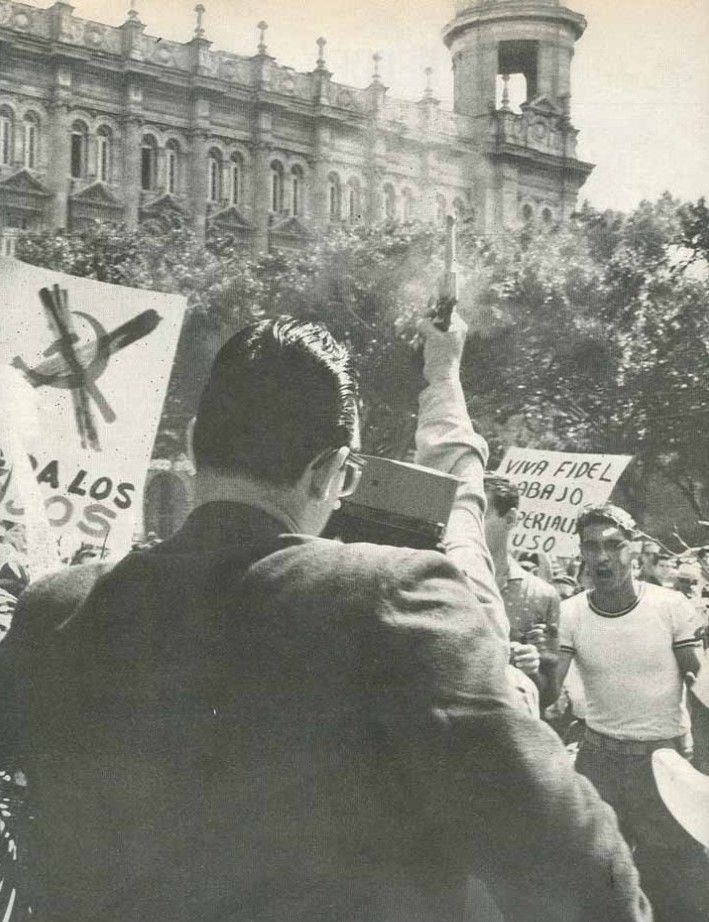
I sensed something unusual had happened when my Dad came to pick me up from school early in the afternoon on February 5, 1961. I was in the sixth grade at Colegio de las Ursulinas de Miramar. Normally at the end of the day I would walk home with my friend Ofelia. We were neighbors and lived a long block away from the school. As soon as I got in the car that afternoon my Dad said: “There was a shootout at the Parque Central today and your cousin Alberto was detained by the police.” My Dad looked worried and I realized that whatever had happened was something very serious. I, too, started to worry about Alberto.
My cousin Alberto Muller, who was 20 years old at the time, was a student at the University of Havana and was a member of the Federación Estudiantil Universitaria (University Student Federation, known as FEU for its acronym in Spanish). He was also a member of the Agrupación Católica Universitaria, (Catholic University Group, known as ACU) an association of Catholic University students attending public institutions such as the Universidad de la Habana, and also private ones, such as the University of Villanova (Universidad de Villanueva) in Havana. Many of these students had been involved in actions against Dictator Batista and had eagerly cooperated with the Revolution after its triumph in January of 1959. Soon they began to realize that the Revolution was turning away from its promises of democracy and freedom.
In early 1960 the students found out that Anastas Mikoyan, a high ranking official of the Soviet Union, would be visiting Cuba. News reports of the 1956 brutal suppression of Soviet troops that suppressed the popular revolt against Soviet control in Hungary was still fresh in their memory – they were well versed in international affairs. Mikoyan’s presence in Cuba was an additional indicator for them that under Castro the Revolution was definitely turning into a dangerous path towards Marxist totalitarianism. Members of the student groups met several times to plan a peaceful demonstration protesting the Soviet official’s visit.
The students found out that on February 5th Mikoyan was to present a wreath of flowers in front of the statue of José Martí, the apostle of Cuban independence, at Havana’s Parque Central (Central Park). They decided to meet at the park and present a wreath of flowers representing the Cuban flag. Hundreds of students attended this peaceful protest. They carried signs saying: “Revolución Sí, Comunismo No” (Revolution, yes. Communism, no.) Another sign said: “Viva Fidel, Abajo el comunismo ruso.” (Long live Fidel, down with Russian communism.) The students were clearly not against the revolution itself, but against the communist infiltration of the revolution.
As the students arrived at Havana’s Parque Central, one of the military guards fired a shot into the air to discourage the public from approaching the statue. Other guards responded by doing the same and the sounds of the shots ricocheted on the tall buildings near the park. A physical battle ensued between the guards and the students. Both wreaths were torn to pieces. The students did not intend to destroy the Soviet’s wreath. All they intended to do was to place theirs next to it. Writing several years ago about this event, my cousin Alberto notes that the wreath that Mikoyan had placed by the statue had a hammer and sickle, which by this time had become a symbol of Soviet communism. The students’ wreath had the colors of the Cuban flag, representing Cuba’s freedom. 1
In his recently published memoir, Three Worlds. A Journey to Freedom, Antonio Garcia Crews, who was one of the organizers of the Parque Central protest, writes about his involvement in its planning. On his way to the park a policeman stopped his car because one of his passengers was throwing out fliers directing people to join the demonstration. The policeman ordered him to drive to the Police Station where he opened the trunk and saw the signs that they had made. As he and his four passengers were ushered into the station they heard the first shot fired by the authorities at El Parque Central – all the protestors were unarmed. During the course of the day other protesters were brought into the station. Twenty one students spent that night in jail. One of them was my cousin Alberto. They were released the next day. 2
Reflecting six decades later on the significance of the Parque Central protest Garcia Crews writes in Three Worlds: “I was 19 years old and still had a few months left to graduate in Economics from the University of Villanueva. I was already convinced that the so-called revolution that had “freed” the country was itself a dictatorship headed in the direction of implementing a dictatorship, worse than the previous one: a Communist dictatorship would guarantee Fidel Castro the absolute and permanent power he yearned for. This was only the beginning. In our case, there was no explanation to jail a group of peaceful and unarmed demonstrators.” 3
About a month later, under extreme pressure by the Castro regime, the Federación Estudiantil Universitaria expelled the leaders of the Parque Central protest from the University of Havana. That included my cousin Alberto. 4
Realizing that there was nothing left for them to do in Cuba, Alberto and several of the leaders of the student group at the Universidad de la Habana left the island. Some went to Latin America, many went to the United States. Antonio Garcia Crews finished his studies at Villanova University, Havana’s Catholic University, and immigrated to the United States to attend graduate school at the University of Chicago. Within a few months Alberto and a group of other student leaders founded in Miami the Directorio Revolucionario Estudiantil (Revolutionary Student Directorate) or DRE for its acronym in Spanish, or simply, Directorio.5 Alberto called Garcia Crews and met with him in New York. Garcia Crews decided to forgo his studies and joined the Directorio. Alberto, Garcia Crews and other of the student leaders returned to Cuba to join the underground fight against Castro. Alberto and Garcia Crews and many others of their student companions were arrested in 1961 and served long prison sentences in Cuba’s political prisons. Some lost their lives.
After their release from prison in the late 1970s Garcia Crews and Alberto were both able to immigrate separately to the United States where they raised their families while continuing to lead a life of dedicated service. Neither one of them has retired. Garcia Crews still practices as an immigration lawyer and Alberto still works as a journalist.
________________________
1 Alberto Muller, Retos del Periodismo,(The Challenges of Journalism)Ediciones Universal, 2008, 27-29.
2 Antonio Garcia Crews, Three Worlds A Journey to Freedom, Ediciones Universal, 2021, 42-43.
3 Garcia Crews, 43-44.
4 Alberto Müller: ‘Fuimos los primeros expulsados de la Universidad de La Habana bajo el comunismo’ (cubalibredigital.com) (We were the first to be expelled from the University of Havana under communism.) August 10, 2021.
5 Garcia Crews, 45-46
 Justice and Peace Shall Kiss