A window into the past
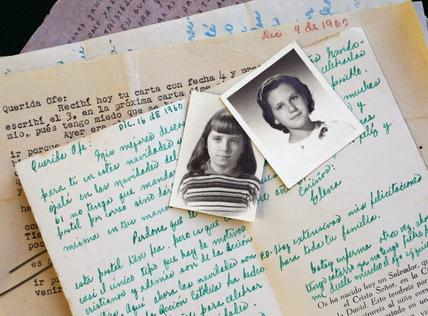
Ofelia (“Ofe”), my best childhood friend, left Cuba on the fourth of July of 1960, exactly one year before I did. She left with her mother, her two siblings and her grandmother. They travelled aboard the City of Havana ferry to Key West. Her father, who was already in Florida, met them there. Eleven days later I received a letter from Ofe to which I replied immediately, starting a correspondence between the two of us that lasted almost a year.
Ofe saved my letters. About twenty years later her mother, Ofelia, gave them to me. I stashed them away in a closet in my parents’ house in Miami. I did not read my letters to Ofe then and with the passing of time forgot about them.
In the Summer of 2009 I found the forgotten stack of letters. As I unfolded and read each letter I felt as if I had opened a window through which I was looking at my past. I read some to Sixto, my husband, and to my brother Javier. We laughed at the jokes I had shared with Ofe some of which were counter revolutionary and we marveled at some of the comments I had dared to write to her about life under the Castro regime.
In a matter of months I typed all the letters on my computer and translated them from Spanish into English. At present they are all printed and kept in a three ring binder with the title Saying Good-By to Havana. As I read them over again I realize they are just the letters of a 12 and then 13 year old girl going through adolescence and confiding in her friend: nothing remarkable. Throughout the letters, however, I included comments and reflections on how the Revolución affected our family, our friends, and our school. Here are some glimpses into my last year in Cuba, from July 1960 when our correspondence began through June 1961, when it ended.
On a letter dated July 15 I inquired about the feasibility of our letters remaining confidential:
“When you reply tell me if anyone else in your house sees the letters that I send you so that I know if I can write about other things”
On that letter I also wrote:
“From here I will tell you that I am resigned to receiving a Russian rocket in my arms, because when they launch it (if they launch it) towards the U.S.A. it could fall here because we are so close.”
The reference to Russian rockets might be puzzling since the Cuban missile crisis did not take place until two years later. However, since the 1950s rumors had already started about the possibility of a nuclear confrontation between the two superpowers of the Cold War. As Castro started to align himself with the Soviets the rumors came closer to home.
The closing of that letter was similar to the way I ended all subsequent ones:
“Good bye from your friend who loves you, does not forget you, misses you, and wishes to see you soon.”
On July 21 I guaranteed the confidential nature of our communications:
“No one reads my letters I have them very well kept in a place from which no one will take them so that you can tell me whatever you want in your letters.”
And then I went on to share a revolutionary joke. The parenthetical explanations are from the original letter. G2 refers to the Cuban General Intelligence Directorate or its agents.
“An American journalist interviews fidel ( lower case on purpose) and asks him when he plans to hold elections in Cuba and fidel answers. – Let G2 tell you.
“The American does not know what that means so he goes to a bar and asks the bartender. The bartender responds: — I do not know any other G2 than the one on the juke box (You know that in a juke box one presses a number and a letter.) So he tells the bartender
“–Look put a nickel in the juke box and press G2 to see what song it plays. The bartender does as told and the juke box plays. “More than a thousand years will pass… (It is the song “Sabor a Mi,”)”
I do remember that this was one of the many jokes making the rounds in Havana at that time. Humor has always helped Cubans cope. In January of 1959 Castro had promised to hold free elections. He postponed the elections at least two times. Unfortunately the joke became true. On May 1 of 1961 Castro declared that there would be no elections and there has not been free elections in Cuba in the past sixty years.
Here is a bit of political commentary that the 12 year old aspiring political pundit I was then wrote to Ofe on September 4:
“About Fidel and his buddies I have to tell you that Fidel is half crazy or at least he pretends to be (I believe that) since he does not even know how to count. At the last rally of stupid imbeciles and communists he said that there were one million people and with that he showed that the majority of the people were on his side in conclusion he said that 1 million was the majority among 6 million and it seems that that is a bit wrong, isn’t that true? I advise him to study his Arithmetic a little more.”
Sixty years later I apologize for the insult to the rally goers. I remember attending at least one of those rallies with my Catholic school, probably in early 1959, when my family still had hopes in the Revolution. I have memories of shouting slogans: Viva Cuba, Cuba sí, Yankees, no! Patria o muerte, venceremos! without really knowing the real meaning of what I was saying. And I pray to God that I never joined in a Paredón chant asking for enemies of the Revolution to be sent to the firing squad, a chant that was quite common at those mass gatherings. I became very cautious in participating in public demonstrations and that has been my wont throughout the rest of my life.
I am fast forwarding now to a letter I wrote on Tuesday May 2, 1961 during the aftermath of the failed Bay of Pigs Invasion when the Castro regime clamped down on the population and thousands of citizens were detained throughout the island, including my 15 year old brother Alejandro. As one would expect of twelve and thirteen year old girls, Ofe and I wrote to each other about boys. Ofe had just written me about a boy, and as I had promised I had put that letter in a secure place, not safe enough, however, to keep it from the milicianos (Castro police) who searched our apartment:
“Listen I tore up the letter where you tell me about the boy because I am afraid that if they come again to search they will read it. Did I tell you that they came to search Saturday before last at 2:30 in the morning. Imagine how sorry I feel for you because they read all or almost all the letters that I have and they must have surely read that one, but don’t worry because the miliciano that read them does not know you. But at any rate I tore it up just in case.”
Our house was not searched again and my brother Alejandro was allowed to come back home. Nevertheless, on May 25 I expressed my determination to leave the island at the first opportunity that would come my way:
“I really want to go there even though I know that I am going to miss mom and dad a lot and pretty Cuba but there I will be able to study and have the peace and quiet that is totally absent here, one day you wake up hearing airplanes and bombs. At night the gun shots from the accidentally discharged bullets and those fired on purpose don’t let you sleep, if you hear a car you think it is a plane, if it thunders, it seems like an air raid, a door that is shut hard sounds like a bomb and finally thousands of things that keep one in continuous shock.”
I have little doubt that I was showing signs of post traumatic stress disorder (PTSD) when I wrote those lines. It is my non-expert opinion that all Cubans who lived through those turbulent times have been affected to some degree by PTSD.
I wrote the last letter to Ofe on June 17. I began the letter by telling her that rumor had it that after the 26th of July no one would be allowed to leave the island. The closing and postscript say it all:
“Your friend who loves you and really wants to go there,
“Me
“P.S. I have entrusted myself to all the saints so that I can soon go there.“
The rumor about Castro ending travel out of the island on July 26th turned out to be false, but I did leave the island on the fourth of July.
*Photo taken from “50 years later, ‘PedroPan’ children celebrate escape from Castro’s Cuba,” Palm Beach Post, Dec. 17, 2010. Lona O’Connor wrote the article. I cannot find the name of the photographer. Ofe’s picture is in the center, mine on the right, both on top of some of the original letters I wrote to her.
 Justice and Peace Shall Kiss