The letters kept me connected to my family
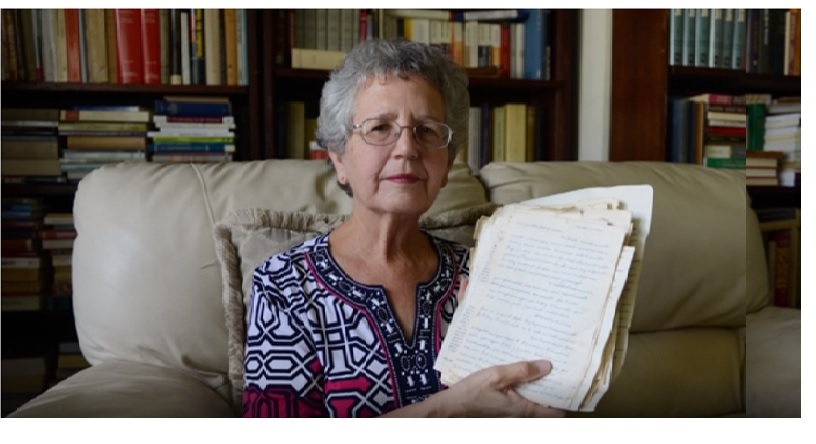
I spent my first summer in the United States in Miami. I stayed at my friend Ofe’s house and on weekends I would visit my aunt Sara and my uncle Panchito. I was getting ready to attend eighth grade at St. Theresa’s school in Coral Gables. Ofe’s mother, Ofelia, was lovingly getting the uniforms ready for me.
During that time I also corresponded with two of the nuns from Colegio de las Ursulinas, in Havana, where I had attended school for eight years. The school had been nationalized and the nuns had left Cuba, but I had managed to stay in touch with them. Just before the new school year started I received a letter from one of the nuns telling me that I had been given a scholarship to attend Ursuline Academy in Dallas, Texas. I told Ofelia and aunt Sara and uncle Panchito. They called my parents in Havana. My parents agreed to my accepting the scholarship and my going to Dallas, Texas. I don’t remember who paid for the plane ticket, but my next memory takes me to my first airplane flight ever.
The first letter I have in my collection is from September 6, 1961. I wrote it to my parents on that flight to Dallas. The thin white stationery on which I wrote in pencil has yellowed and there are several tears on the edges. The corners are dog-eared. There are several fold marks indicating the many times the letter has been folded and unfolded. Defying the passage of time, the cursive writing is still legible.
Here is a translation of a segment from the original Spanish:
“Dear papi and mami,
“Today I start a new adventure, which, God willing, will be for my own good. At this very moment I am flying through the clouds, I am thrilled because this is the first time I am riding on a plane, but every once in a while, as is happening right now, I wish I could see you, and since I can’t, my tears betray me. You know how much I miss you…”
What I did not tell my parents in that letter is what I had wished for just before writing it. This is a memory that I have carried with me since that day. As the plane took flight I was overcome by the realization that I was leaving behind my aunt and my uncle, my best friend and her welcoming family and that I was going to be even further away from my parents and my brothers. At that moment I prayed that the plane would fall in order to put an end to the extreme sadness I felt. That prayer lasted a nano second. I immediatley took it back. “No, Lord, I did not mean it. No please, don’t let the plane fall,” I prayed with all the strength of my soul. Luckily the second prayer was heard, and I arrived safely at Dallas Lovefield Airport that afternoon.
Carlos Eire, a most eloquent Pedro Pan, has written two memoirs, one of which, Waiting for Snow in Havana won the 2003 National Book Award. In his 2010 sequel, Learning to Die in Miami, death and resurrection is a theme that recurs throughout his masterfully written work. I experienced death and resurrection on that flight to Dallas. My death wished morphed into love for life, and thus I ended the letter on a cheerful note:
“Know that I am enjoying this trip. Mami, I think about how much you would like to ride on a plane, and you are right. I love you and remember you with all my heart, Elena”
That is one of many letters that I wrote my parents. Early on I asked them to save them and return them to me. They did just that and for that I am forever grateful. My collection also includes the letters that my parents wrote me as well as letters from each of my brothers and from some of my relatives. These letters kept me connected with them when I was thousands of miles away. Sixty years later the letters still connect me to my parents even though they passed on to eternal life more than a decade ago.
A week ago on a visit to friends in Altamonte Springs, Florida, I came across a news report about a new policy the Florida Department of Corrections (FLDC) wants to implement. It immediately caught my attention. In order to curb contraband, FLDC plans to digitalize all the correspondence that the inmates receive from their families and provide it to them only on tablets. At a hearing that was held on June 10th the relatives pleaded for that plan to be scraped arguing that the physical letters, the photographs, the drawings from their children are a lifeline to the inmates. “Handwritten letters are our hug, our touch,” one witness said. **
Siding with the relatives and friends of the inmates were federal public defenders and several organizations including some libertarian and conservative leaning groups and churches and ministries. If I had attended that hearing I would have joined my voice to theirs. I can attest that hand written letters are indeed hugs and touches when we are separated from those we love. And that is true even in this digital age.
_________________________________________________________________
* This photo is taken from Former Pedro Pan kids look back in exhibit. By Johnny Diaz, South Florida Sun Sentinel, July 1, 2015.
** “Letters are the lifeline”: Families plead for Florida prisons to retain physical mail. By Grace Toohey, Orlando Sentinel, June 11, 2021
 Justice and Peace Shall Kiss